Social Media Copilot: one brief, a week of posts for every platform
I designed Copilot end to end at Kumba: one brief becomes a reviewed plan, platform-ready posts and a schedule. It’s the product Kumba raised its Series A on, at a $10M valuation.
Timeline
Aug – Sep 2026 · ~2 months
Contributors
Product designer (me) Founders and developers
My contribution
Research End-to-end design in Figma Coded prototype for the team
Problem
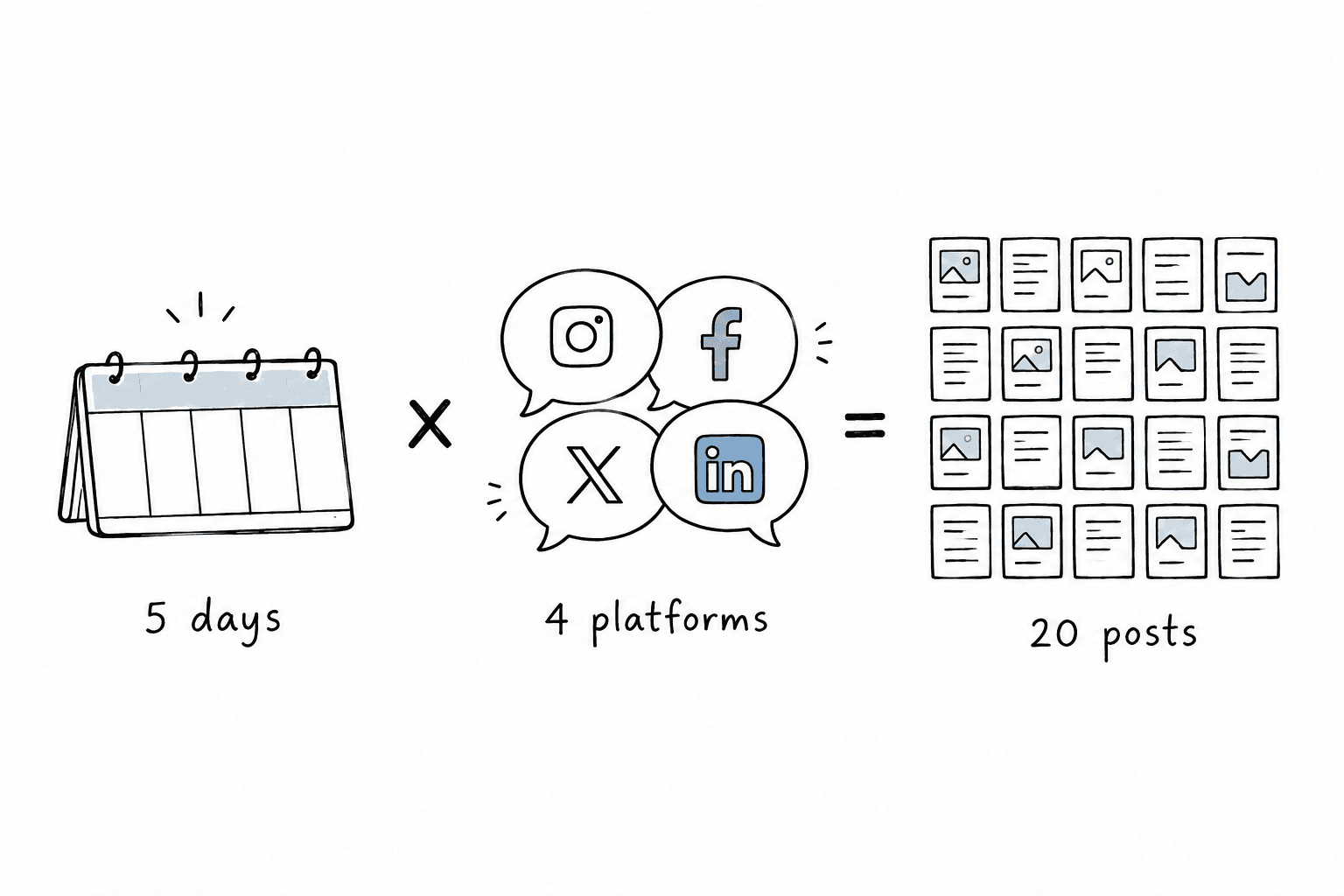
Kumba makes AI marketing tools for brands and agencies. A social media manager running a five-day launch on four platforms makes 20 posts and 20 captions, spread across several tools.
Plans lived in spreadsheets, images in Canva, captions in notes.
Every platform meant resizing and rewriting.
Scheduling meant moving it all into another app.
Root cause: nothing stored the campaign, so every tool started from scratch.
Where it started
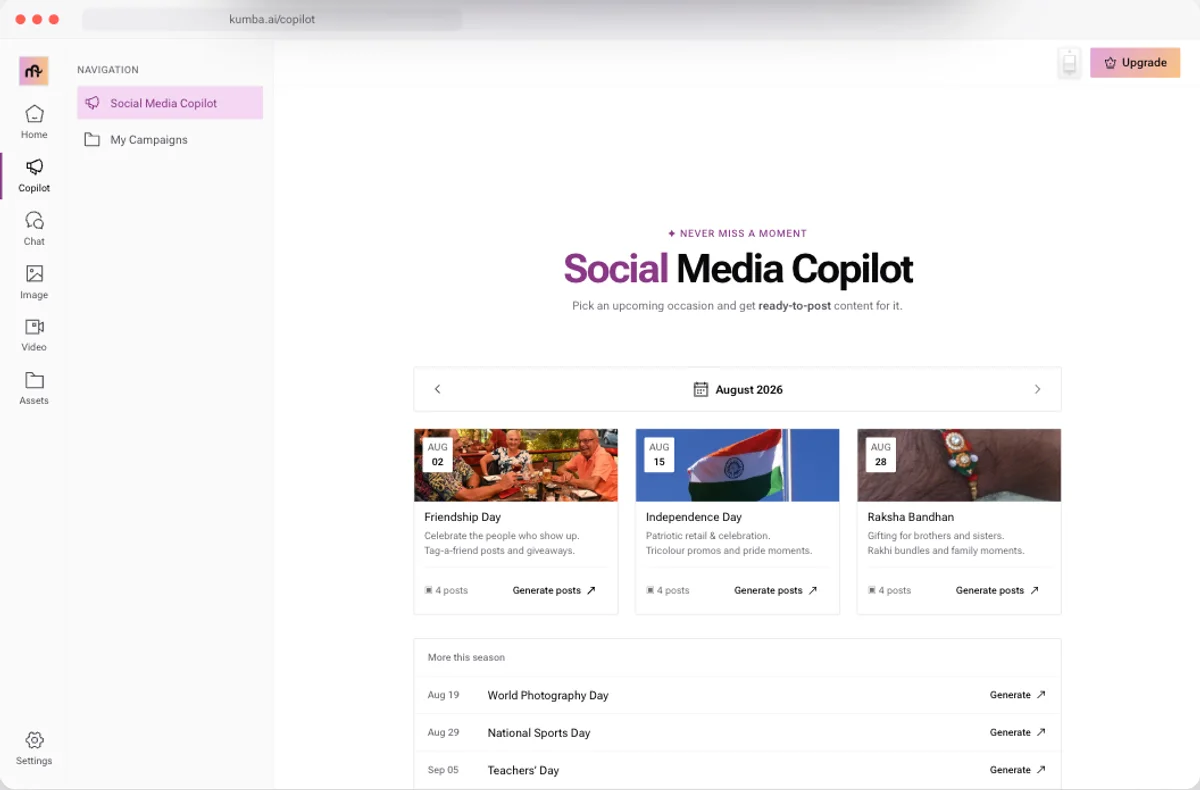
Copilot didn’t start as a campaign tool. The first version was event-led: pick an upcoming occasion, like a festival or a national day, and get posts for it. There was no way to start from your own campaign.
Two things shaped that version. Technically, generation worked one occasion at a time, so it couldn’t hold a single brief steady across several days and platforms. And the founders believed in moment marketingBrands joining a festival, a national day or a news moment while people are already talking about it.: Indian brands win attention on topical posts, the way Amul has for decades.
The belief had data behind it. In YouGov’s 2023 festive study of 2,010 urban Indians, social relevance was the top reason a festive ad stood out (49%). So the question was never whether occasions matter. It was where they sit in the way marketers actually plan.
How I researched it
Over the two months I kept talking to agency people: social media managers, account managers and freelancers who run several clients at once. They were semi-structured interviewsA short list of fixed questions, with room to follow whatever the person brings up., and the most useful prompt was always the same: walk me through your last campaign, from the client’s brief to the last scheduled post.
I grouped what I heard with affinity mappingWriting observations on notes and clustering them until patterns show up. and framed the core job to be doneThe progress a person is trying to make in a situation, independent of any product.:
When a client signs off a brief, I want to turn it into a week of on-brand posts for every platform, so I can get one approval and ship without rework.
Notice what the job doesn’t mention: occasions. Events show up inside the job, as days in a plan. They are not where it starts.
The mismatch
The biggest finding was a mental modelThe picture in someone’s head of how a thing works. Products feel easy when they match it. mismatch. Agencies think in campaigns: a launch, a sale, a quarter. The first Copilot thought in occasions. So users had to break their campaign into events before the product could help, which is backwards.
Campaign first, moment second. An Independence Day post that ignores the launch running that week reads as off-brand. People wanted the occasion folded into the campaign’s message.
Adapting is rework, not craft. Resizing for each feed and trimming captions to each limit was the part nobody wanted to do twice.
Trust is earned before generation. People were happy to let AI draft, but only if they could steer the direction before twenty posts existed.
Sprout Social’s 2025 Index points the same way from the audience side: consumers want brands to understand the context of a cultural moment, not recreate every meme. Context lives in the campaign, not in the calendar.
What that meant for the product
In the event-led version, the event was the main object. Nothing stored a campaign, so there was nothing for later steps to read from. The fix was to make the campaign the single source of truthOne place where a piece of information lives, so every other step reads it instead of copying it.: one object holding the goal, brief, positioning, dates, channels and brand assets.
Every generated post points back to it. Change the core message once and the plan, the posts and the schedule all follow. Occasions became days inside that object, which is how they could finally take the campaign’s context with them.
HypothesisA prediction we can test by watching what people do.
If users can correct one plan and carry it through creation and scheduling, they should need fewer tool handoffs and fewer edits to publish.
So I put a plan before generation. It costs one step, and it’s the step that makes the output trustworthy.
How we’d know
Success signal: Users complete campaigns in Copilot and publish most posts with few edits.
Failure signal: Users still need other tools to finish, or keep regenerating instead of publishing.
Why a plan, not a prompt
Nielsen Norman Group watched people work with generative AI and named two habits that waste time: accordion editingRepeatedly asking the AI to make its answer shorter or longer to land on what you wanted. and apple pickingRetyping or pasting bits of earlier AI answers into a new prompt to reuse or fix them.. Both come from interfaces where the only way to fix output is to ask again.
Their advice was to let people edit part of a result directly, and regenerate only that part. That’s the shape of Copilot’s plan: a human-in-the-loopA checkpoint where a person reviews and corrects AI work before it moves on. checkpoint, broken into sections you can edit or refine one at a time.
The options we weighed
Generate everything at once. Fastest first result. But a wrong angle meant fixing it in twenty places, and people fell back to regenerating.
Refine in a chat. Familiar, but it pushed people straight into accordion editing, and a chat log is a poor place to review a week of content.
Review a structured plan first. One extra step, but every fix happens where it’s cheapest. This is what we shipped.
To keep the extra step light, the plan uses progressive disclosureShow the essentials first and reveal detail only when someone asks for it.: sections stay collapsed until you open one, and editing happens in place.
The AI made 20 posts.All with the wrong angle.
What changed along the way
Where a campaign starts
RejectedEvent-ledPick an occasion, get posts for it. There was no way to start from your own campaign.
AcceptedCampaign-ledStart from your own brief. Occasions become days inside it, and the brief adjusts for that day.
AcceptedPlan firstReview the plan, then generate. Fixing a plan takes seconds.
Two months of iteration
We built Copilot over about two months, with a lot of back and forth. Each round followed the same loop: design in Figma, build a coded prototype, review it with the founders and developers, then put it in front of agency people and adjust.
From events to campaigns. The pivot itself. Occasions moved from the entry point to optional days inside a campaign.
From a long form to three inputs. Early briefs asked for too much up front. We cut to a goal, a short brief and a product photo to lower the cognitive loadHow much someone has to hold in their head at once to use something. of starting.
From generate-first to plan-first. The call above, made once it was clear how expensive fixes became after generation.
From a separate schedule screen to scheduling in the editor. Reviewing a post and setting its time are one decision, so they live in one place.
Everything was built on Kumba’s design system, so new screens reused existing components and the developers could ship each round without one-off UI.
Meet the product
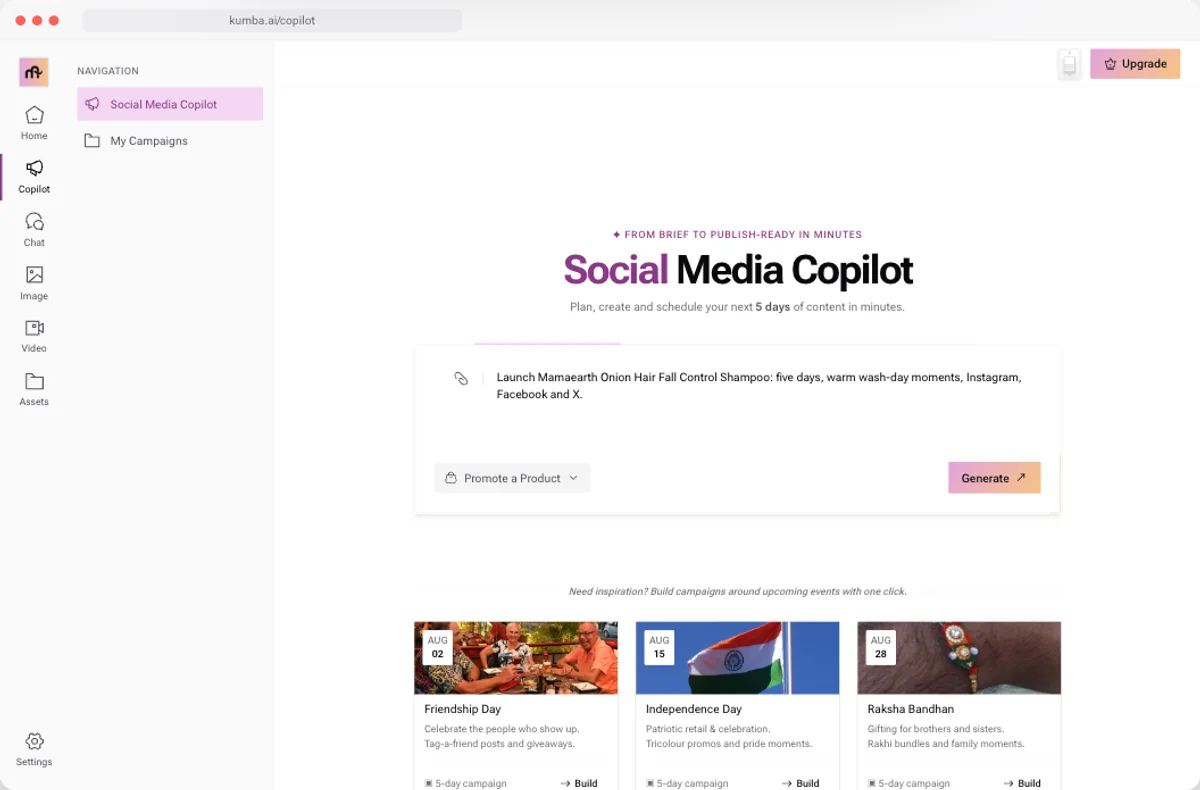
1. Start with a brief
Add a goal, a short brief and a product photo. Upcoming dates can join as campaign days.
In detail
This is where the pivot shows. The campaign is custom: it starts from the user’s own goal and brief. Upcoming dates still appear, but as suggestions. Add Independence Day to a skincare launch and that day’s brief adjusts: the post keeps the launch’s message and finds an angle that fits the occasion, instead of becoming a generic flag post.
Goals come from a short fixed list, so the plan knows what success looks like before anything is generated. That small constraintA deliberate limit on choices that makes the next step easier and the result more predictable. gives generation a clear target, which a free-text goal doesn’t.
Start with a brief, goal and product photo
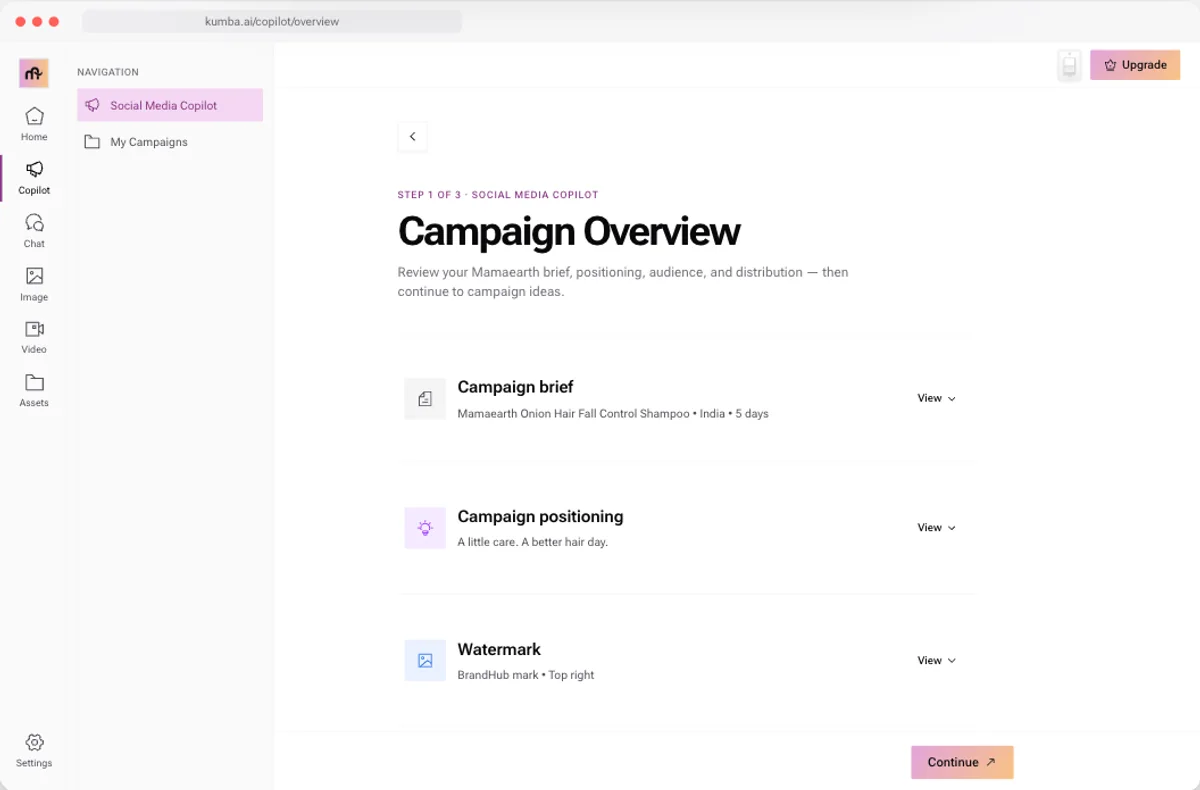
2. Review the plan and ideas
Correct the direction once, not twenty times.
In detail
The plan’s information architectureHow content is grouped, ordered and labelled so people can find and understand it. follows the order agencies sign things off: the brief, the positioning and core message, brand marks, then where it goes.
Positioning can be refined or replaced with a new direction, without touching the rest of the plan.
Watermark exists because agencies put the client’s mark on every post, and doing it by hand per image is exactly the rework we were cutting.
Distribution picks the platforms once, so nobody re-selects them per post.
Review the campaign before creating posts
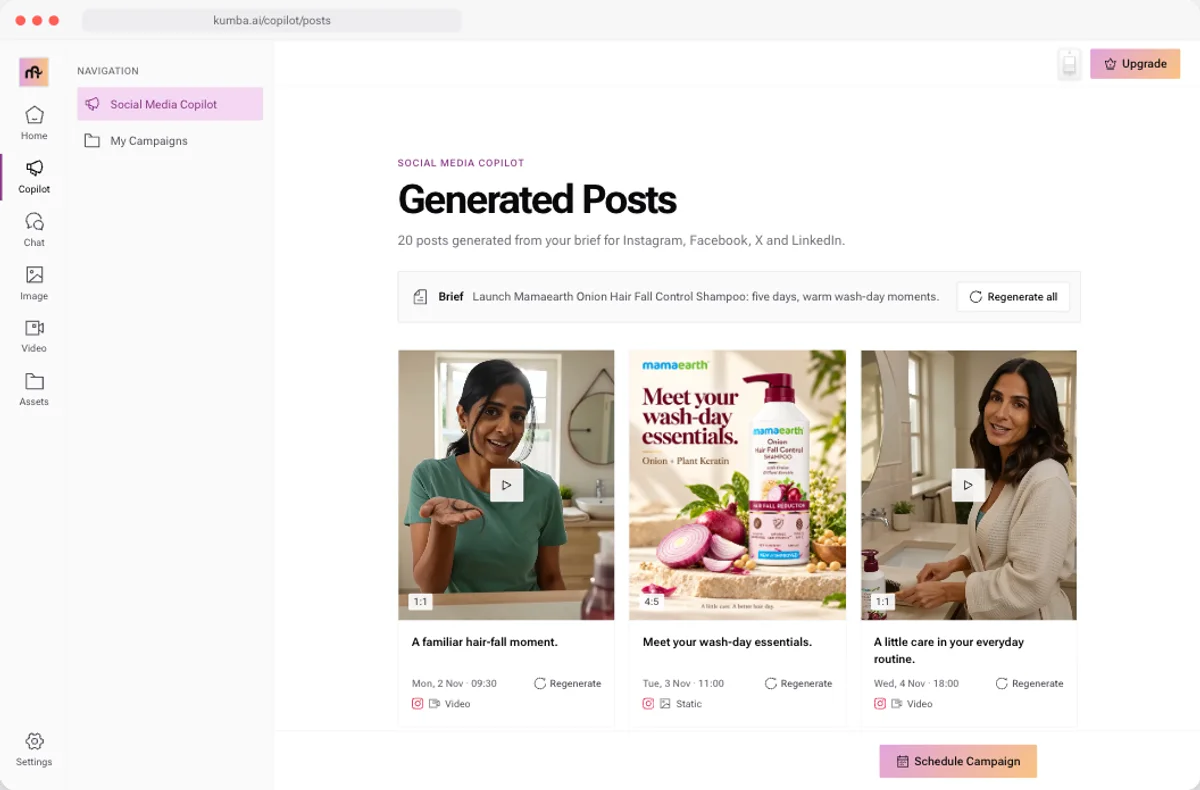
3. Generate for each platform
Each idea becomes a post in each platform’s format and voice.
In detail
Platform-native means more than resizing. Each platform gets its own aspect ratio, caption length and tone, within the same campaign message. X has a 280-character limit for most accounts; Instagram allows up to 2,200. The caption is rewritten for each, not truncated.
Generation takes a moment, so the grid uses a skeleton stateA placeholder shaped like the content that’s coming, so waiting feels shorter and nothing jumps when it loads. and reveals posts as they’re ready.
One idea, four platforms. Switch to see the size and caption change.
mmamaearth@mamaearth · 1h
Hair fall season? Meet our new Onion Hair Fall Shampoo. Onion oil + keratin. 🧅
1600 × 900 · Wide
Short and direct, under 280 characters.
A five-day campaign, ready to review
4. Edit and schedule
Preview, edit and schedule without leaving the post.
In detail
The editor previews each post at its real feed width, so what you approve is what people see. A segmented control switches platforms without leaving the post, and each caption has a live counter against that platform’s limit.
If a caption runs over, scheduling is blocked with a plain reason: shorten the X caption to schedule. That’s error preventionDesigning so mistakes can’t happen, instead of explaining them after they do. at the point it matters, not an error after the post fails to publish. Each post also carries its own date, time and timezone, because agencies often post for clients in other cities and countries.
Preview, edit and schedule in one place
Impact
4,400campaigns generated
1,200Pro upgrades
71%posts scheduled without edits
3m 40smedian brief to scheduled week
Series A at a $10 million valuation. Kumba pitched Social Media Copilot on Falcons of Majlis, the startup funding show.
What I learned
A strong belief can be right and still be the wrong entry point. Moment marketing works. It just belongs inside a campaign, not in front of it.
The data model is part of the design. The pivot was really a change in what the product stores. The screens followed from that.
With AI, design the correction, not just the generation. The plan step is where trust gets built.



 1600 × 900 · Wide

